
 3075290078
.jpg) 4169005786
4169005786ATAC LH: 1st Line of Defense
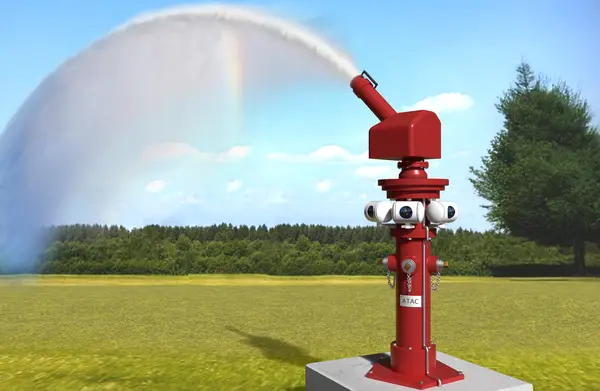
IQTech Labs and our trust partner Fire Fighting Systems AS (FFS) have developed the LH (Large Hydrant) as the primary line of defense to protect high density value infrastructure, assets, homes and commercial buildings from wildfires.
ATAC LH (Large Hydrant) is engineered to swiftly detect, inhibit, and extinguish the chain reaction of combustion through a continuous, high-concentration water stream. Unlike traditional firefighting methods, which depend on often-limited existing water infrastructure, ATAC necessitates a dedicated water source capable of delivering massive volumes rapidly and consistently, regardless of drought or competing demands.
BENEFITS
The ATAC system represents a significant advancement over traditional wildfire defense strategies due to its proactive approach and unprecedented water delivery capacity. While other methods like aerial firefighting and manual firefighting, have their roles, they are often limited by factors such as:
Water Availability: Traditional methods rely on existing water sources, which may be limited or unavailable during a major wildfire.
Weather Conditions: High winds and extreme heat can severely limit the effectiveness of aerial firefighting.
Response Time: Traditional methods may not be able to respond quickly enough to rapidly spreading wildfires.
A New Era in Firefighting: Innovative Features of ATAC
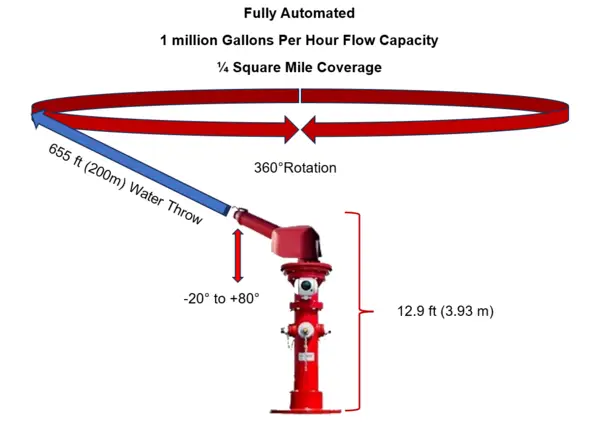
The ATAC system is designed with breakthrough technology, fundamentally transforming our approach to modern firefighting. One of its most remarkable features is its unparalleled water delivery capacity: up to 1 million gallons per hour (approximately 3.8 million liters per hour) delivered precisely on target. To put this into perspective, this represents a staggering 2,400 percent (24 times) increase in effectiveness compared to the Boeing 747 Supertanker's 41,600 gallons per hour discharge capacity, currently one of the largest aerial firefighting tankers in the world.
Drastically reducing setup time and operating costs, this capability enhances firefighting feasibility and effectiveness while minimizing disruptions to urban landscapes. Furthermore, the system can irrigate drought-ravaged flora as a preventative measure when not actively suppressing fires.
ATAC delivers the highest level of safety security and protection possible to guard against wildfires.
Control and Monitoring System: Intelligent Fire Detection and Response
The ATAC system's control and monitoring system is its "brain," providing real-time situational awareness and enabling rapid, coordinated response to wildfires. Key features include:
Sensor Integration: The system will integrate data from various sensors, including heat sensors, smoke detectors, and weather stations, to detect and track wildfires.
Satellite Imagery: Integration with satellite imagery, potentially through platforms like Axon's Fusus, will provide a broad overview of the fire situation and allow for early detection of ignitions.
Automated Activation: Based on pre-programmed parameters and real-time data analysis, the system can automatically activate the LHV Towers, delivering water to the most critical areas even before human operators can intervene.
Remote Control and Monitoring: Operators in a central control center can monitor the system's status, adjust water delivery parameters, and manually control the LHV Towers as needed.
Data Logging and Analysis: The system will record all relevant data, providing valuable information for post-fire analysis and system optimization.
Helicopter Support (Optional):While the ATAC system is primarily a ground-based solution, helicopters like the Erickson S-64 Sky Crane could provide essential supplemental support.
The ATAC system, incorporating advanced technologies like the ATAC LH (Large Hydrant) represents a groundbreaking approach, poised to redefine firefighting operations with its proactive strategy, unparalleled efficiency, and long-term resilience.
The escalating severity and frequency of wildfires, fueled by climate change, demand innovative solutions. The ATAC system represents a crucial advancement in firefighting technology, enabling more efficient and effective operations globally. By mitigating the devastating impact of these fires, ATAC plays a pivotal role in protecting communities and safeguarding our planet against the growing threat of climate change.
Unmatched Performance for a Changing World: 1 million gallons per hour
The FFS 4000 JSP monitor distinguishes itself with exceptional performance. Capable of delivering about 1 million gallons per hour (4000m³/hour). It offers unmatched efficiency in the face of quickly spreading forest fires. Such capabilities have become indispensable, as highlighted by severe fire seasons around the world. The FFS 4000 JSP potent combination of high flow rate and operational efficiency is crucial for effective fire control, significantly mitigating the environmental and health impacts of wildfires.
Engineered for Extreme Conditions
Designed to endure the harshest environments, the FFS 4000 JSPengineering ensures it can confront the multifaceted challenges of urban, suburban, rural, and industrialforest fires.
Water Source Flexibility
A key advantage of the FFS 4000 JSP its flexibility in utilizing different water sources, including both sea and freshwater. This adaptability is vital, enhancing efficiency and enabling quicker response times across a spectrum of firefighting scenarios, positioning the FFS 4000 JSP as an essential tool in the battle against wildfires.
Robust, Durable, and Tested Extensively
The FFS 4000 JSP is built to last, designed to withstand the rigors of firefighting and ensuring reliability and performance that firefighting teams can count on in the long haul.
The vertical and horizontal movements are operated by electrical motors via gearboxes. All gears are completely sealed from the surroundings, thus eliminating accidental contact. Robust hand wheels made from composites and stainless steel provide manual back-up operation for the monitor movements. The Jet/Screen selection is electrically operated by a solenoid valve with manual override.
ATAC PUMPS
|
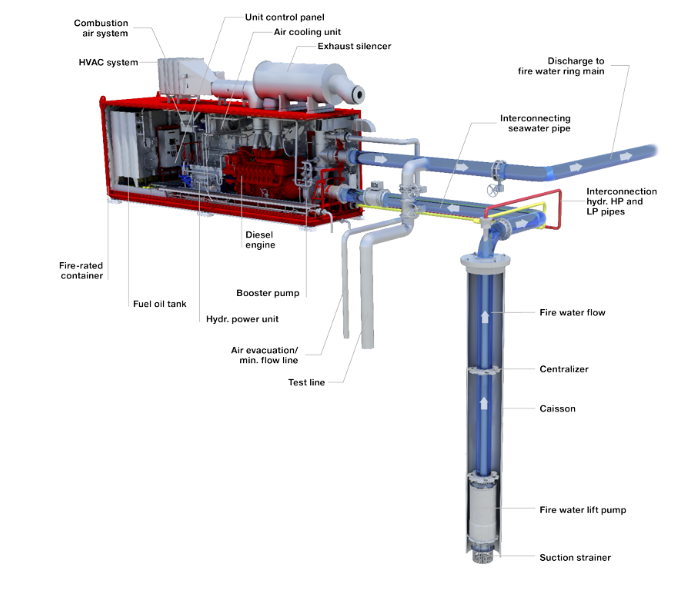
A submersible deep-well pump or a long-axle deep-well pump—installed within the well to lift water up to a booster pump at ground level. The following schematic illustrates a hydraulic or electric lift pump which brings water up to the booster pump on ground which will boost up the pressure to a pressure which is suitable to feed the large capacity ATAC LH monitors. |